HIGH VACUUM ENGINEERING
Manual High-Vacuum Poppet Valves
Miro HAS angle and HLS inline manual high-vacuum poppet valves are available in KF16, KF25 and KF40 and use SUS316L metal corrugated bellows; dimensions, specifications and 3D models are provided.
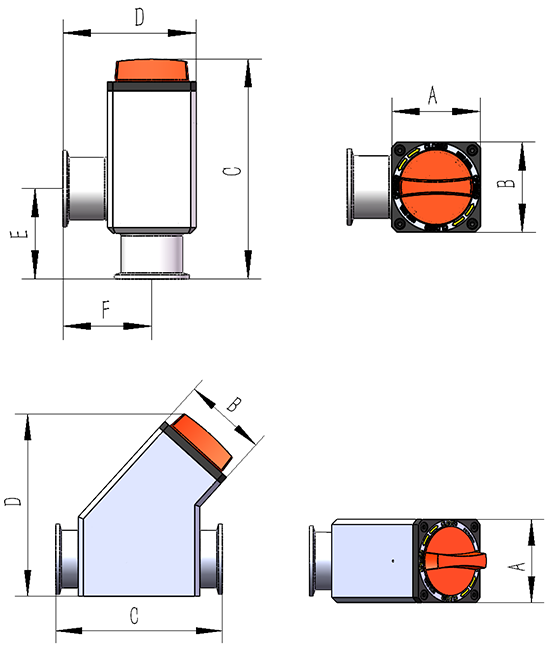
Manual angle valve (HAS)
Angle valve size chart (unit: mm)
| Model | A | B | C | D | E | F |
| KF40 | 65 | 65 | 158 | 97 | 65 | 65 |
| KF25 | 52 | 52 | 132 | 78 | 50 | 50 |
| KF16 | 42 | 42 | 107 | 61 | 40 | 40 |
Manual inline valve (HLS)
Inline valve size chart (unit: mm)
| Model | A | B | C | D |
| KF40 | 65 | 65 | 158.5 | 142 |
| KF25 | 52 | 52 | 132 | 106 |
| KF16 | 42 | 42 | 107 | 93 |
Parameters
| Available port sizes | KF40,KF25,KF16 |
| Body material | A6061 aluminum or SUS316L stainless steel (one-piece, weld-free construction; mirror-polished surfaces). |
| Dynamic seal | SUS316L metal corrugated bellows |
| External Leakage* | <1 × 10⁻¹¹ Pa·m³/s (1 × 10⁻¹⁰ mbar·L/s) |
| Internal Leakage* | <1 × 10⁻¹⁰ Pa·m³/s (1 × 10⁻⁹ mbar·L/s) |
| Operating pressure | 1×10⁻⁹ mbar to 2000 mbar |
| Maximum forward operating pressure | 2000mbar |
| Maximum reverse operating pressure | 1200mbar |
| Sealing material | FKM |
| Maximum process-gas temperature | < 250 °C (with the valve body maintained at room temperature) |
*Note 1: The external leakage rate is defined as the rate at which external air permeates into the interior of the valve, mainly influenced by the quality of the sealing surface and the material of the O-rings. External leakage can be detected through external helium testing (poor quality sealing surfaces may rely on vacuum grease for temporary sealing, but vacuum grease will fail over time, leading to increased external leakage. Additionally, vacuum grease can also increase the internal leakage).
*Note 2: The internal leakage rate is influenced by the cleanliness inside the valve and the degassing performance of the internal materials. Oil and water stains can significantly increase the internal leakage rate (manifested as extremely high background levels in leak detectors). Dust, O-ring materials, and the internal surface quality of metal materials are also influencing factors, such as porous anodic oxide layers that can severely affect the internal leakage rate.